Newsletter Subscribe
Enter your email address below and subscribe to our newsletter

 ByJohn A
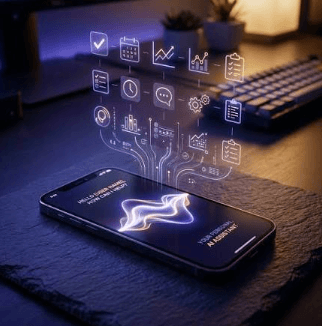
AI-enabled mobile assistants now balance on-device processing with multi-modal inputs to boost accuracy and privacy. Edge intelligence reduces latency and data leakage while supporting personalized experiences. Proactive, context-aware conversations promise lower friction but raise questions about control and data economy. With continual learning and aggregated prompts shaping routines, the trade-offs between privacy, usefulness, and adaptability warrant systematic evaluation before broader adoption. The stakes suggest a careful path forward as capabilities mature.
AI-driven mobile assistants have markedly improved in accuracy, responsiveness, and context handling, driven by advances in on-device ML, multimodal inputs, and continual learning. This progress enables more reliable task execution, better inference under limited bandwidth, and cohesive user flows.
Empirical tests emphasize privacy by design and latency optimization, ensuring efficient responses without compromising user autonomy or data stewardship.
On-device intelligence optimizes privacy, latency, and personalization by performing processing locally rather than sending data to cloud services. This approach enables privacy preserving on device models, reducing exposure and regulatory risk.
Empirical evaluations show measurable edge latency optimization and faster response times, sustaining user autonomy.
Rigorous experimentation supports personalized adaptations with limited data leakage, promoting trusted, responsive, and configurable mobile assistants.
The analysis evaluates contextual prompts and adaptive tone, testing how proactive cues align with user intent without intrusion.
Empirical results emphasize low latency, transparent rationale, and user autonomy, guiding scalable, privacy-preserving conversational strategies for proactive support.
From reminders to routines, mobile personal assistants shape durable user behavior beyond individual tasks by aggregating discrete prompts into cohesive, automated patterns.
This evolution improves planning and data economy by converting scattered signals into actionable workflows, enabling scalable optimization.
Multimodal interactions enrich reliability, reducing cognitive load while increasing reliability.
Builders gain measurable feedback loops, guiding iterative experiments and principled feature prioritization for broad, freedom-oriented adoption.
To balance personalization with consent, mobile assistants implement explicit opt-ins, granular controls, and transparent prompts; they rely on strict user data governance and ongoing, data-driven evaluations to verify that personalization aligns with user preferences and privacy expectations.
AI assistants can support context understanding across apps only if cross app privacy is preserved; safe data sharing hinges on strict permissions, isolate app data, transparent policies, and rigorous experimentation to demonstrate reliable, privacy-preserving cross app context handling.
Constant listening increases energy consumption, but wake word models and efficient hardware improve energy efficiency; trade-offs include privacy trade offs and potential misfires, yet rigorous experimentation supports feasible defaults for users seeking freedom.
See also: erikkapostcom
Bias mitigation strategies are implemented through model auditing, adversarial testing, and red-teaming, then iteratively refined. Data drainage, fairness metrics, and transparent reporting drive improvements; ongoing monitoring ensures alignment with user autonomy and democratic values.
Offline capabilities can reduce cloud dependency, enabling modest improvements in resilience and privacy. The analysis emphasizes offline learning and on device privacy, showing trade-offs in model size, latency, and data security; results support cautious, data-driven experimentation and freedom.
In the quiet circuitry of daily life, on-device intelligence acts as a faithful lantern—brightening paths without exposing shadows beyond the user’s pocket. Privacy is the frame, latency the hinge, personalization the grain that ages well. Conversations become proactive, like a compass tuned by context, while routines weave a steady, private backbone for action. For builders, data economy is the map; iterative feedback is the compass. Together, they converge on trustworthy, scalable, perceptive assistants that respect user autonomy.